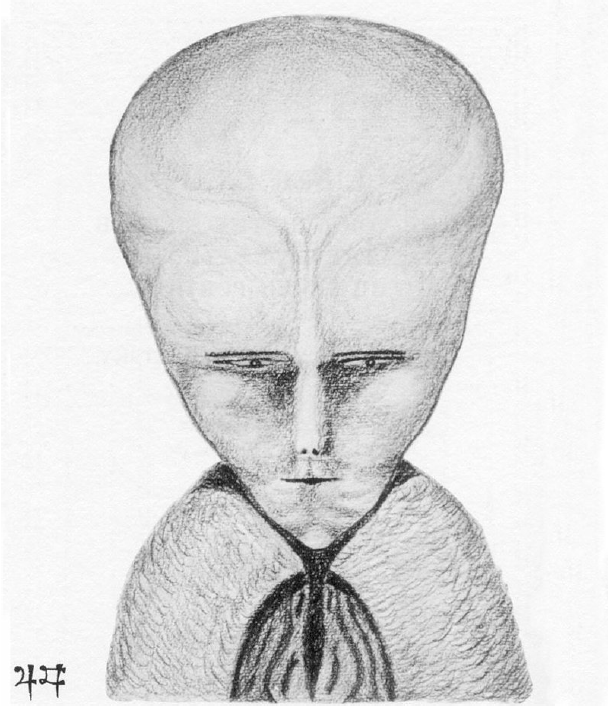
Aleister Crowley's drawing of LAM has, over time, become the source of a great many speculations.
It originally served as the frontispiece accompanying his commentary on "The Voice of the Silence" by Madame Blavatsky, arguably considered the single most important text of Theosophy. According to Blavatsky, the text was a compilation of fragments from an ancient "Book of the Golden Precepts." Crowley claimed this wasn't true; that the text was fictitious, mixing and muddling Hindu and Buddhist concepts. But even so, he said, whether it was genuinely an ancient Eastern text was beside the point, since what mattered was that Blavatsky had attained the grade equivalent to Master of the Temple in the A∴A∴, and at that level, even a false text would also be true.
"The Voice of the Silence" was published in the magazine The Equinox, in the first issue of its third volume (also known as The Blue Equinox), as a supplement under the title Liber LXXI. Crowley signed the commentary as Frater O.M., his magical name upon taking the grade of Adeptus Exemptus in the A∴A∴.
In the magazine, as a preface to this Liber LXXI, the illustration was published followed by this text:
Lam is the Tibetan word for Way or Path, and Lama is He who Goeth, the specific title of the Gods of Egypt, the Treader of the Path, in Buddhistic phraseology. Its numerical value is 71, the number of this book.
There the matter might have rested, but in 1945 Aleister Crowley gave this drawing to Kenneth Grant, and for Grant it became something of an obsession.
In 1972, in "The Magical Revival," the first volume of his Typhonian Trilogies, Grant republished the drawing, flatly declaring it to be "Lam, an extraterrestrial intelligence with whom Crowley made astral contact in 1919. This drawing by Crowley was exhibited at a show held in Greenwich Village, New York, that same year." Later, in "Outside the Circles of Time," he would instead claim that LAM appeared to Crowley in Greenwich Village in 1918, through a series of visions and communications mediated by Roddie Minor that would come to be known as the Amalantrah Working, which can be read in full in his "Liber XCVII" (though the reader shouldn't expect to find any mention of LAM in it).
In his book "Cults of the Shadow," published in 1975, Grant tells us that Michael Bertiaux, author of the Voudon Gnostic Workbook, made contact with this entity in the 1960s while working with Bön-Pa, the traditional religion native to Tibet that predates the arrival of Buddhism there. Bertiaux in turn claimed that this was the same entity he had worked with, in a Voudon context, alongside Lucien-François Jean-Maine, a Haitian adept known to Papus, founder of the OTOA which Bertiaux would eventually come to lead.
Grant also states here that "certain adepts of the New York OTO, led by Soror Tanith (Janice R. Ayers), have made contact with this entity." Over these years a "Cult of LAM" had gradually been taking shape, alongside Kenneth Grant's founding of his own OTO, the Typhonian OTO. Soror Tanith edited its official bulletin, MEZLA, of which 13 issues were published between 1973 and 1983, and in which thirteenth issue there appeared a theoretical-practical manual titled "On the Cult of Lam: The Dikpala of the Path of Silence."

Grant would also state, in "Cults of the Shadow," that LAM is a Tibetan word meaning "god" or "extraterrestrial intelligence"... which isn't actually true. As he would later correct in "Outside the Circles of Time," the meaning of LAM in Tibetan (ལམ་) is simply "the path," precisely as Crowley indicated on the drawing itself. Among its various meanings in Tibetan, in particular, it denotes the path of practice that leads toward enlightenment.
In "Cults of the Shadow," Grant suspects it might be a portrait of Aiwass under one of the disguises in which he appeared to Crowley, "or a portrayal of the elemental dwarf-soul typified by the Phallus, or the head of the spermatozoon which, in the symbolism of Thelema, is identified with Hadit, the inner light of every man and the instrument of his True Will." Later, in "Outside the Circles of Time," he returns to the idea that LAM might be a form of Amalantrah. There too, using gematria, he identifies LAM with the Egyptian Set and with Lovecraft's Yog-Sothoth, in an ever-expanding mythologization. In the same book, Grant returns once more to the idea of Aiwass, presenting him as Crowley's "personal Lama," while also capable of communicating with others.
He further states that LAM is "the link between the systems of Sirius and Andromeda," as well as between the Aeons of Horus and Maat, eventually elevating it to "the Magus of Maat," a presence perceived by Nema Andahadna and Lugis Thor. This tendency, which continues in other texts as well, leans toward associating LAM with balance and the path to silence, and thus with this silent Aeon of Maat.
Grant never quite settles, however, on whether LAM is an extraterrestrial entity from some distant star system (counted, in particular, among the so-called "greys", a resemblance that lies at the root of much of this speculation, and not only in Grant's work), or an entity of inner space.
In "Hecate's Fountain" (1992), he claims it to be an archetype that has been observed within the UFO phenomenon on numerous occasions, bringing us back once more to "the greys." In "Outer Gateways" (1995), LAM has become part of a group of extraterrestrials who descended into Tibet around 9000 BC and later escaped to organize a secret kingdom on the plateau of Leng, the very one conceived by H. P. Lovecraft.
He also assigns importance to the "Egg of Lam" as a kind of spaceship used to mentally explore extraterrestrial dimensions, entering it through its eyes and identifying oneself with it, wearing it like a mask that protects one from the aliens.

Aleister Crowley riding the Egg of Lam, a dramatization
Kenneth Grant proposed this meditation as a way to bring things into practice:
Gaze at the portrait until drowsiness supervenes. The gaze will naturally rest upon the eyes; these will appear to enlarge and will suck in the consciousness until there arises a sensation of being within the entity's head. Two ways are now open: either upward or downward. If downward the descent will be accompanied by a sensation of rushing air that may atlain gale force. A deep blackness will engulf the mind as one enters the dark tunnel beneath the mouth of Lam, and the wind will be replaced by a sound of rushing waters. They will boil around the face of Lam until a brilliant and flashing flame streaks like lightning through the oily and agitated liquid. Its churning will awaken the image of an octopoid entity, the tentacles of which are the branchings of the tunnel below the mouth of Lam. There will follow a sudden quietude stirred only by the vague pullulations of the squid-like entity. In that quietude contact may be established with the network of tunnels ramifying downward to the base of Lam, where the sexual lightnings have their origin. These transport the mind into a violent vortex and consciousness will appear to diffuse in a myriad shapes that are borne swiftly upward to fuse into a single shape. The fusion will occur between the eyes of Lam, in the region of the ajna chakra, and the flame will shoot aloft into the vast brilliance of a cranium that appears infinite in extent and dazzlingly lustrous.
The mantra lpsoslam, or Lamipsos, should then be vibrated according as to whether the tunnels are ascended or descended.
[Kenneth Grant - Outside the Circles of Time]
And also:
The mode of Entering the Egg may proceed as follows. Each votary is encouraged to experiment and to evolve his own method from this basic procedure:
1) Sit in silence before the portrait.
2) Invoke mentally by silent repetition of the Name.
3) If response is felt to be positive, but not before, enter the Egg and merge with That which is within and look out through the entity’s eyes on what appears now to the votary an alien world. (Adumbrations of identity with Lam may be experienced as a strong sense of the unreality, or unfamiliarity, of the ’objective’ universe.)
4) Seal the Egg, i.e. close the eyes of Lam and await developments.
5) At the first sign of stress or fatigue, return to mundane consciousness by opening the eyes and by oozing out of the Egg in a form determined by the experiences within.
6) Perform, astrally, the Banishing Ritual of the Pentagram of Earth, at the Eight Spaces, and record all experiences in detail, paying particular attention to lunar phases (celestial and, where applicable, terrestrial), and any physiological phenomena accompanying the experience.
The invocation of Lam should be performed only in a fully protected Circle, which involves Banishing in the Eight Directions of Space with the Lesser Banishing Ritual of the Pentagram of Earth, followed by the Invoking Ritual of the Hexagram of Earth. Then, proceed with a silent invocation of Aiwass, and intense aspiration to Yuggoth (Kether) and the Great Old Ones, before actual LAMeditation commences.
[Kenneth Grant - On the Cult of Lam: The Dikpala of the Way of Silence]
For Michael Staley (editor of Kenneth Grant's work), in his 1994 essay "The Mysteries of Lam," the extraterrestrial doesn't refer so much to beings "from outside" in a physical sense, as to states of consciousness that transcend the merely human and terrestrial. In other words, the extraterrestrial would be whatever lies beyond the limited consciousness of the human vehicle, part of a continuous cosmic consciousness. In turn, entities like Lam or Aiwass are not absolute "others," but facets of that same continuum, just as the magician is. "Alien" contact, then, would consist of contact with broader levels of one's own universal consciousness.
Michael Staley proposed the following practical method:
In the course of my own magical work, I have developed the following brief evocation of the Portal:
Lam!
Thou Voice of the Silence,
Glyph of Hoor-paar-kraat:
The Dwarf-Self, the Hidden God.
Gateway to the Aeon of Maat!
I evoke thee! I evoke thee!
With the mantra Talam-Malat, Talam-Malat, Talam-Malat...
[Michael Staley - The Mysteries of Lam]
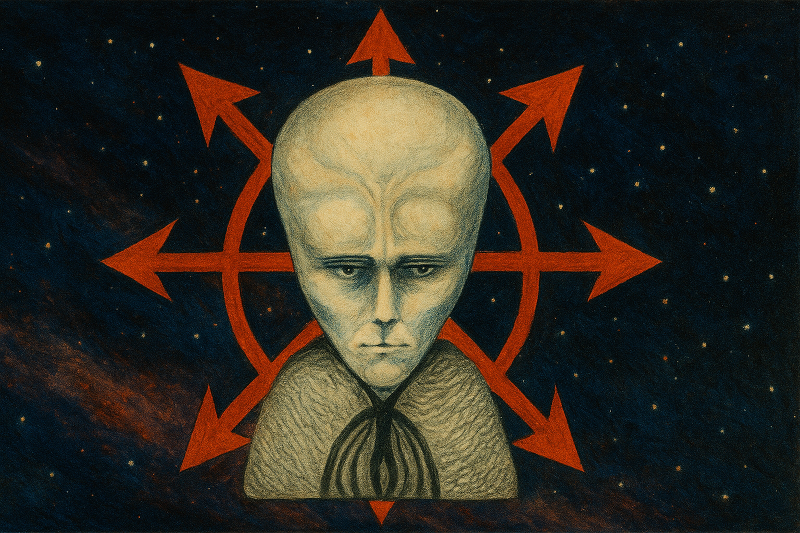
Chaos magician Phil Hine also leans toward this idea. In a short piece on the subject, he states that between 1986 and 1989 he attempted to establish contact with LAM through dreams, clairvoyance and ritual, and that the results led him to hold the hypothesis that LAM functions as an "access portal" to strange strata of consciousness within the Typhonian paradigm, an entry point to extraterrestrial Consciousness.
He goes on to note the significance of the pairing between the LAM portrait and "The Voice of the Silence": LAM, he suggests, can be read as a glyph of that "voice," the dwarf-ego or Hidden God, with the Egg standing as a glyph of birth and potential, making LAM a portal-entity into the Gnosis of Illumination, one from which there is no return, at least not in the same condition one entered. He also draws a link between LAM and "the Forgotten Ones," the dark entities analogous to Lovecraft's Great Old Ones within Soror Nema's Maatian current, and suggests LAM might likewise be read as a mask for mental emptiness; the very thing that lets the Voice arise.
In practical terms, Phil Hine writes that during a 1988 ritual exploration of the Egg of Lam he perceived a serpentine entity bearing the Seal of Babalon on its forehead, and he offers a simple method of exploration.
For this, one is to use some image of LAM in order to "establish contact or communication with the strata of consciousness of which LAM is the mask." He recommends first performing an LBRP (Lesser Banishing Ritual of the Pentagram) or a Star Ruby, and then proceeding to the working itself:
Sit so that you can gaze fixedly at the image of Lam, using an asana such as the Dragon posture. Still all thoughts and mentally vibrate the name LAM until you feel a "contact". While doing this, try to project your consciousness into the image, so that it becomes a mask through which you gaze out (upon a now-strange world). Close Lam's eyes and await developments.
At the first sign of fatigue, withdraw from the mask and banish carefully. Please keep a record of any visualizations experienced, psycho-physical sensations, or other occurrences.
[Phil Hine]
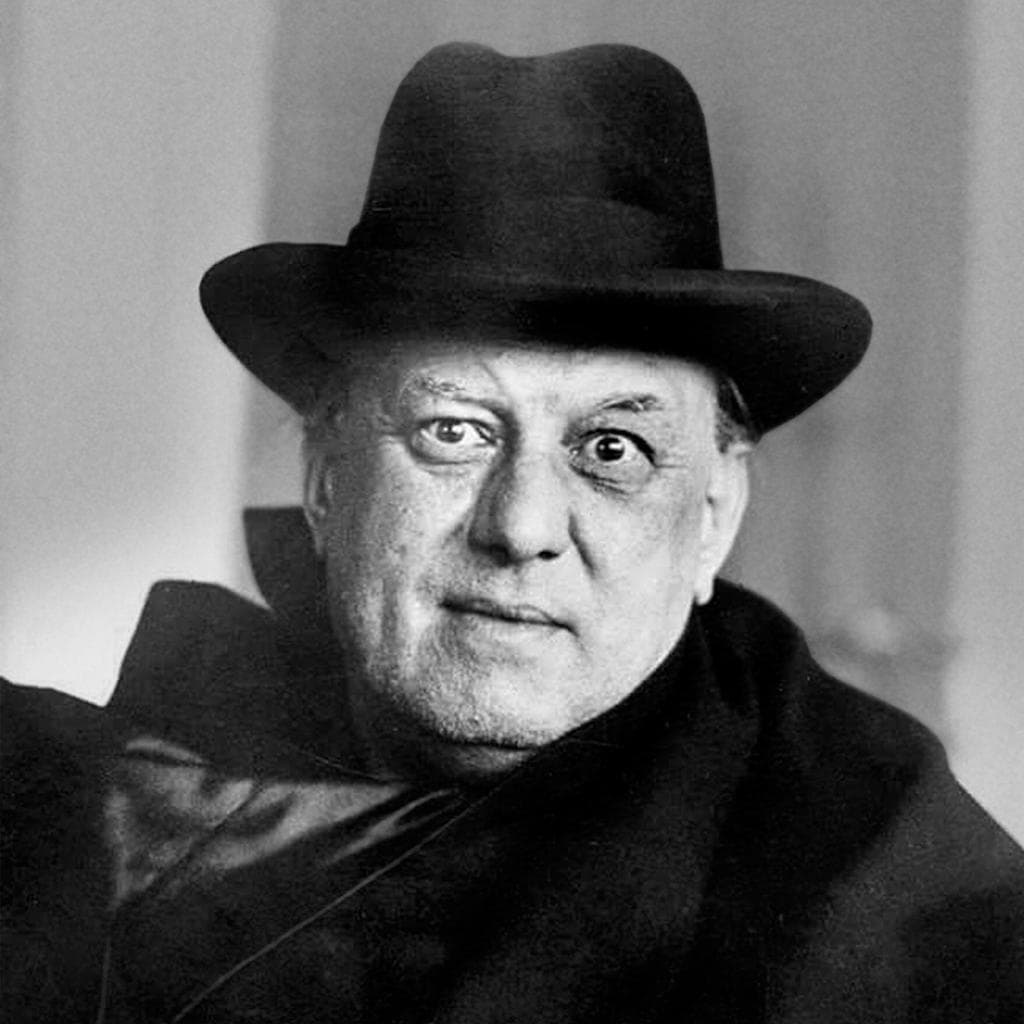
Now, it needs to be said plainly: all of this is elaboration. The author of the drawing, Aleister Crowley, never once claimed LAM to be an entity, let alone an alien. When he used it as a cover image for "The Voice of the Silence," as noted at the start, he didn't even specify the word LAM as a proper name. If anything, Michael Staley recounts hearing the testimony of an American visitor to Crowley's London flat in 1941, who said Crowley had the portrait hanging on the wall; and that when asked what it was, Crowley simply replied that it was a portrait of his guru.
In other words, what we're looking at are later speculations originating with Kenneth Grant, though, admittedly, given how things tend to work in magic, that's no reason they couldn't also be useful speculations. If LAM has become a sigil through which to explore states of consciousness or astral places we'd consider "alien" simply because of their strangeness, then perhaps asking Crowley what he actually meant has become somewhat beside the point.
This wouldn't be the only time Kenneth Grant takes a fragment of Crowley and builds an entire little universe out of it, much as happened with the Tunnels of Set.
Another, less fantastical hypothesis, from Gary Dickinson, is that the LAM portrait is actually a self-portrait of Crowley, and that LAM is also I AM. At the time he published this issue of The Equinox, Crowley was symbolically angling to be accepted as a master by the Theosophical Society, which is what led him to write this commentary on Blavatsky's book, and to present himself, on the cover, as a Tibetan lama, playing to an organization that considered Tibet the dwelling place of the Masters.
Or, though it might seem too simple, we could just take LAM literally as The Path, recalling how Crowley tells us in Chapter 13 of The Book of Lies that our final goal is to become the path itself: "O thou that drawest toward the End of The Path, effort is no more. Faster and faster dost thou fall; thy weariness is changed into Ineffable Rest. For there is not Thou upon That Path: thou hast become The Way."
I'd like to close this piece with a suggestion I think rather fitting, given who Crowley was and his somewhat sideways way of pointing at things: perhaps what Crowley was really gesturing toward was the sex magic he prized so highly.
Perhaps, instead of a lama or a big-headed alien in some strange coat that looks like it's made of hair, he was pointing us toward something else entirely.
To see it more clearly, all you have to do is turn the image upside down. It becomes quite easy, then, to stop seeing a fur coat and instead see, now at the top, a vulva. Surrounded by hair. With menstrual blood. And below it, a penis mingling with that same blood.
What if, with this, Crowley was slyly pointing us toward one of his favorite secrets of sex magic?

